

An odd stat, that I had to check three times as I didn’t quite believe it, that I came across today, is as follows. In 2026, Mondays account for 80% of the S&P 500’s year-to-date gain.
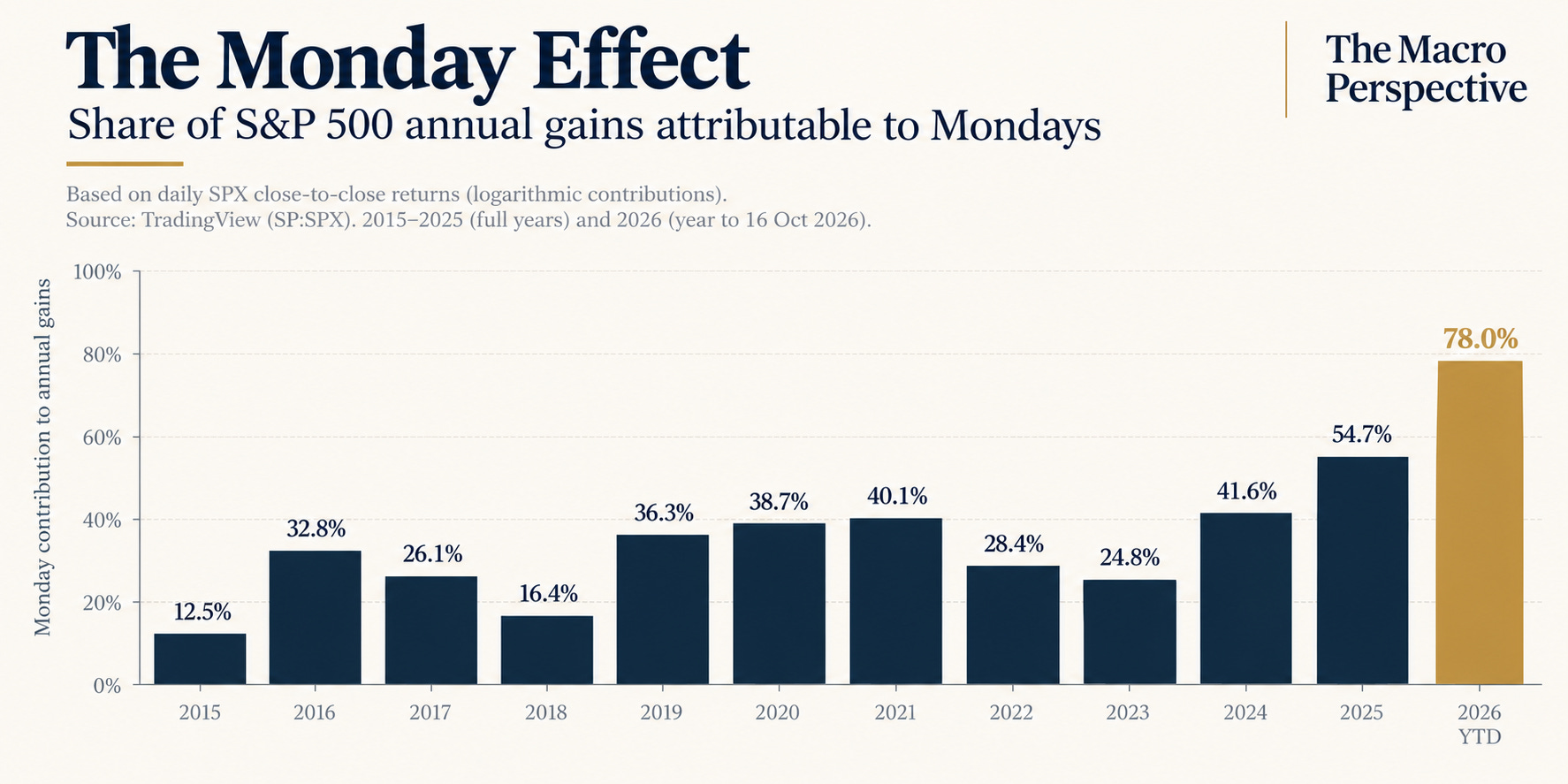
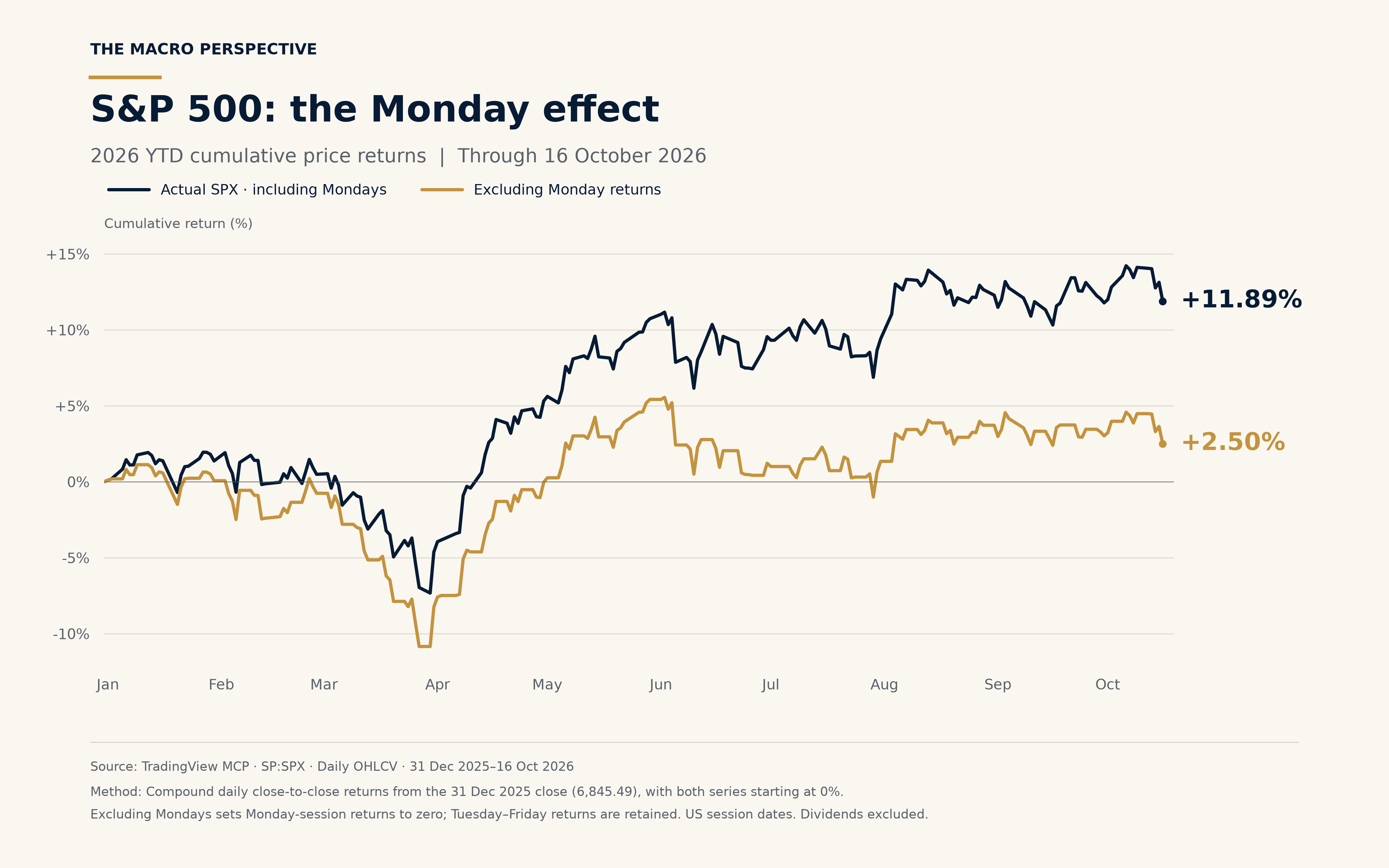
If you’re so minded to check my maths - the benchmark is up approx 12% YTD, with the compounded Monday return amounting to just under 9.2%, leaving the return excluding Mondays at 2.5%. A simple division, and you get the rather surprising stat above. As the chart shows, this is a fairly new phenomenon, and one which is much more prominent this year, than in those gone by.
What’s not unusual, though, is the ‘hit rate’, or the proportion of Mondays on which the S&P 500 has ended the day in the green. That’s hovering at around two-thirds of all Mondays this year, pretty much bang in line with the recent past.
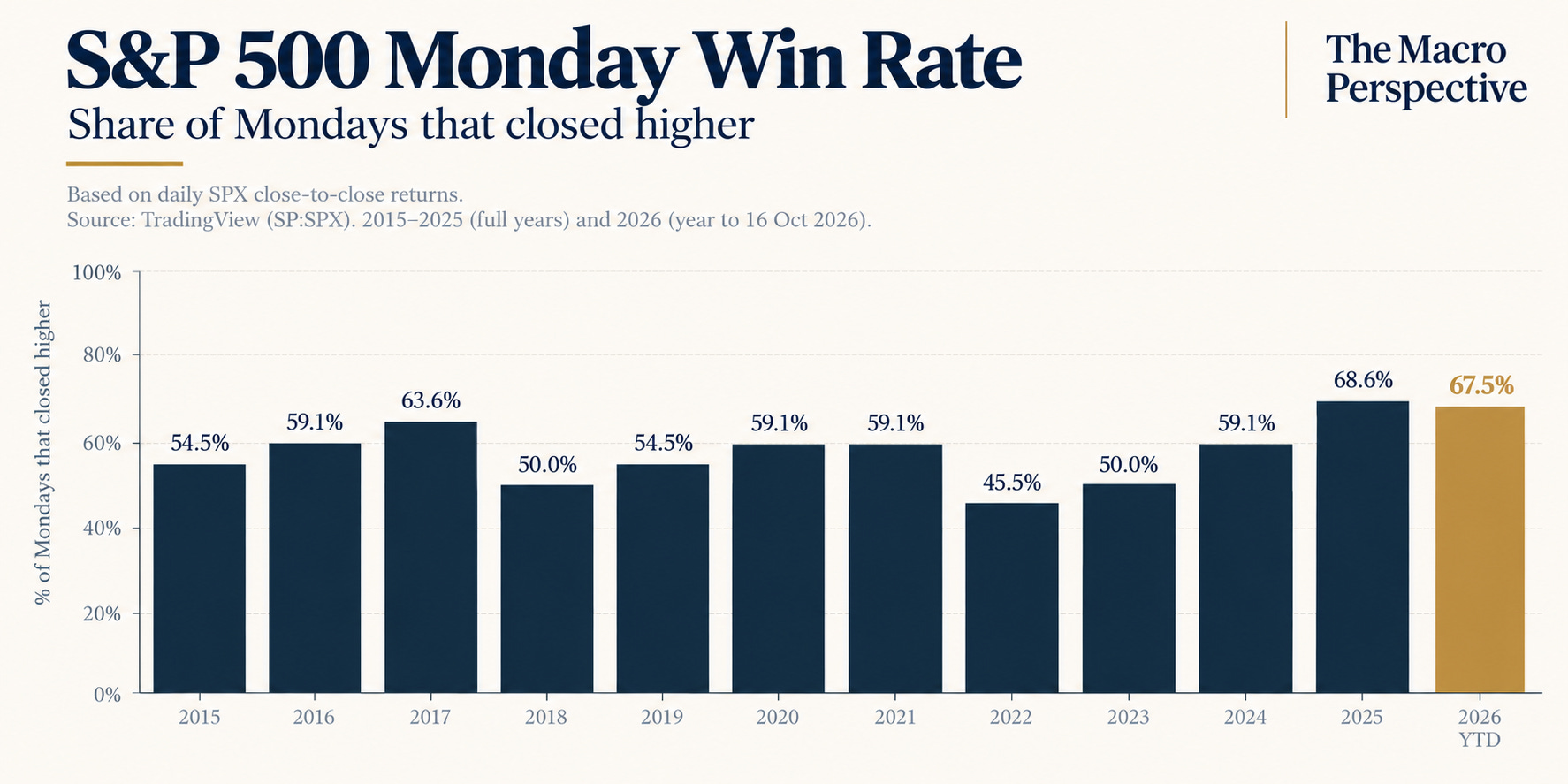
This suggests, to me at least, that the slightly ridiculous contribution of Mondays to the overall performance of the equity benchmark this year has much more to do with the magnitude of the rallies that we’ve seen to start the week, than it does with the frequency of those gains.
In fact, the numbers back this up. On average, this year, the S&P has gained around 0.25% on the first day of the week, compared to the 5-year average of an 0.09% gain.
All this is very interesting, but what use is it?
Well, none of this is to say that we are guaranteed to gain ground every Monday, or that this phenomenon is guaranteed to continue forever more. However, when markets display quirks like this, they do deserve some pondering.
Having done that pondering, I’d wager that what we see here is similar, in some ways, to the well-known ‘Turnaround Tuesday’ effect - just on a different day!
Namely, that market participants have displayed a notable tendency to take risk off the table into the weekend throughout the year, hardly surprising given the fluid geopolitical backdrop, before adding that risk back again as the trading week gets underway, either without the escalation that those participants were hedging having taken place, or with a positive catalyst having emerged while markets were closed. Of course, this is just an educated guess, but it seems plausible enough to me.
Perhaps the biggest takeaway, though, is that all this data supports the adage that time in the market beats timing the market. As mentioned earlier, stripping out Mondays would’ve proved very costly indeed this year, in a useful example of how costly trying to time market moves can be. Equally, it’s a useful reminder that betting against the market’s ability to continue climbing a ‘wall of worry’ is seldom a wise idea.
Disclaimer
The information and opinions contained in this publication are provided for informational and educational purposes only and should not be construed as investment advice, a recommendation, or an offer to buy or sell any financial instrument.
All views expressed are solely those of the author and are subject to change without notice. While every effort is made to ensure the accuracy of the information presented, no representation or warranty is made as to its completeness or accuracy.
Readers should conduct their own research and, where appropriate, seek independent professional advice before making any investment or financial decisions. The author accepts no liability for any loss arising from reliance on the information contained in this publication.
Any references to specific securities, asset classes, markets, or investment strategies are provided solely for illustrative and analytical purposes and do not constitute investment recommendations.